Y – On planetary mythology (Genna)

The new mythologies of the capital can be observed at work in every aesthetic element of our life, which acquires the function of an entry point to our epoch’s consciousness. There are books, for example, that become manuals of neoliberal ideology. Dies Irae by Giuseppe Genna (2006) is one of them. Dies Irae is one of the masterpieces of the New Italian Epic nebula. It opens with the story of Alfredino Rampi, the young victim of the Vermicino incident in 1981. The book’s incipit transforms the tragic accident into a mysterious occurrences at the centre of a whirlwind of events from Italy’s Second Republic: the arrest of Licio Gelli, the puppeteer of P2 (a deviant Masonic Lodge that had gained enormous external influence over the country); the assassination attempt of Pope John Paul II; the ENI-Petromin scandal; the charismatic role of the country’s President and former partisan Sandro Pertini; the rising fortune of Silvio Berlusconi, among others. This glimpse of recent Italian history is attributed to a shady character observing in the background, a CIA collaborator named Aberdeen, who embodies the turbid ‘other side of the story’. In the book’s unfolding, Alfredino’s body in the well will reveal itself as a trope of catabasis: a descent into the underworld that precedes a rebirth, performed by a sacrificial hyper-protagonist who never takes part in the story in first person. One particular interpretation of this twofold symbolic movement (descent and rebirth) is authorized by the text: Alfredino is a world-soul operator that marks the end of an epoch and the beginning of a new one. The epoch that comes to an end is Western postmodernism; the one that springs up, a planetary age that Genna seems to regard as yet to fully surface. According to an established understanding, postmodernism is characterized by Genna as the age of paranoia. The postmodern world is a paranoid world, as the saturation of planetary space is infinitely redoubled by the emerging society of spectacle. American postmodernist literature, as well as thriller as a consumer genre, mimic the new devices of political control, refined during the McCarthy era. Writes Genna (2006, p. 698): Thriller served to interpret a state of society: the generalized and popularized state of paranoia. […] An advanced society of information provides the individual with fragments of reality that trigger a first-level interpretive game: the mystery that arises from joining news distant from each other. And a saturation of the white noise of prevailing communication imposes to the same individual a consolidated and undiscussed, mysteriosophical and secularly orphic belief: I wonder what’s behind it, they are not telling the truth, there’s another truth behind. How nice it would be to find out. In the words of Thomas Pynchon, a postmodernist story stands on “nothing else than the onset, the leading edge, of the discovery that everything is connected” (Pynchon, 1973, p. 703). In highbrow and lowbrow fiction undistinguishably, “the reader, stunned, lost, overwhelmed, battered, and mired in a crazed array of characters, plots, various conspiracies, and alliances, gropes for clues and connections, and is thus forces to try and make sense of what she is reading. The novel seems to beg to be allegorized, fit into some massive blueprint or game plan as the reader becomes her own conspirator […]. Conspiracy becomes a lived experience, an attempted gathering of correspondences, hidden web of networks and zones” (Coale, 2019, p. 213). The literary spirit of the postmodern epoch reveals a pathological reconstitution of magical thinking that determines and distributes life as an enclosed domain of sovereignty. The fringes of post-War Italian intellectuals that were closest to postmodernism expressed a distinctively humanist declension of the psychopolitics of paranoia, epitomized by Italo Calvino’s Sfida al labirinto (“challenge to the labyrinth,” as reads the title of Il menabò 5 from 1962). This stance ultimately died out together with the social and political struggles of the 1970s. At the time of the Vermicino incident, Italy was on the brink of a new “epoch of enjoyment,” as Genna makes Aberdeen say (Genna, 2006, p. 31); Alfredino’s tragic catabasis both fulfils and overcomes the paranoid world of postmodernism. As one of the first mediatic cases in Italian history, Vermicino indeed was the manifestation of the new theology of spectacle, or the new constitution of a collective gaze and its related symbolic economy. Alfredino’s sacrificial claustrophobia stood for everyone’s paranoia, dictating the porous and labyrinthic structure of narration of Dies Irae. On the other hand, Vermicino was also an event of transformation that—as Aberdeen comments—stood at the beginning of a new phase of Italian history, the so-called epoca del riflusso (“reflow age”). Genna imagines that Alfredino, turned into the removed object of desire of millions of spectators, morphs into something else: stuck in the artesian well (which is more similar to a narrow and convoluted cave than to a vertical corridor), his body loses sight and motility; he experiences a regression into the inorganic (he “falls into the crystal,” like the protagonist of Hoffmann’s The Golden Pot). Towards the end of the book, the reader finds again Alfredino in the guise of a cosmic infant encountered by a space mission in the distant future. It is the second part of the catabasis, rebirth. We can use a geontological vocabulary (see Povinelli 2016) to conceptualize this movement as symbolic of a new repartition of life and non-life. Despite its global projection, postmodernism was still an epoch of paralysis of the bios within the geos, a stage in the history of life on the planet. After postmodernism, the repartition between bios and geos no longer stands: now a planetary bios–geos is opposed to another absolute otherness, a non-planetary dimension associated with the dead recesses of space and time. A new great Inside—the planetarized human species—is placed against a new great Outside, embodied by the figures of outer space and extinction. Alfredino’s transformation into an infinitized being through the well, then, symbolizes the advent of the planetary age, defined by a new transcendental configuration
International Conference “Time, Art and Subjectivity”
https://timeandimages.wordpress.com/
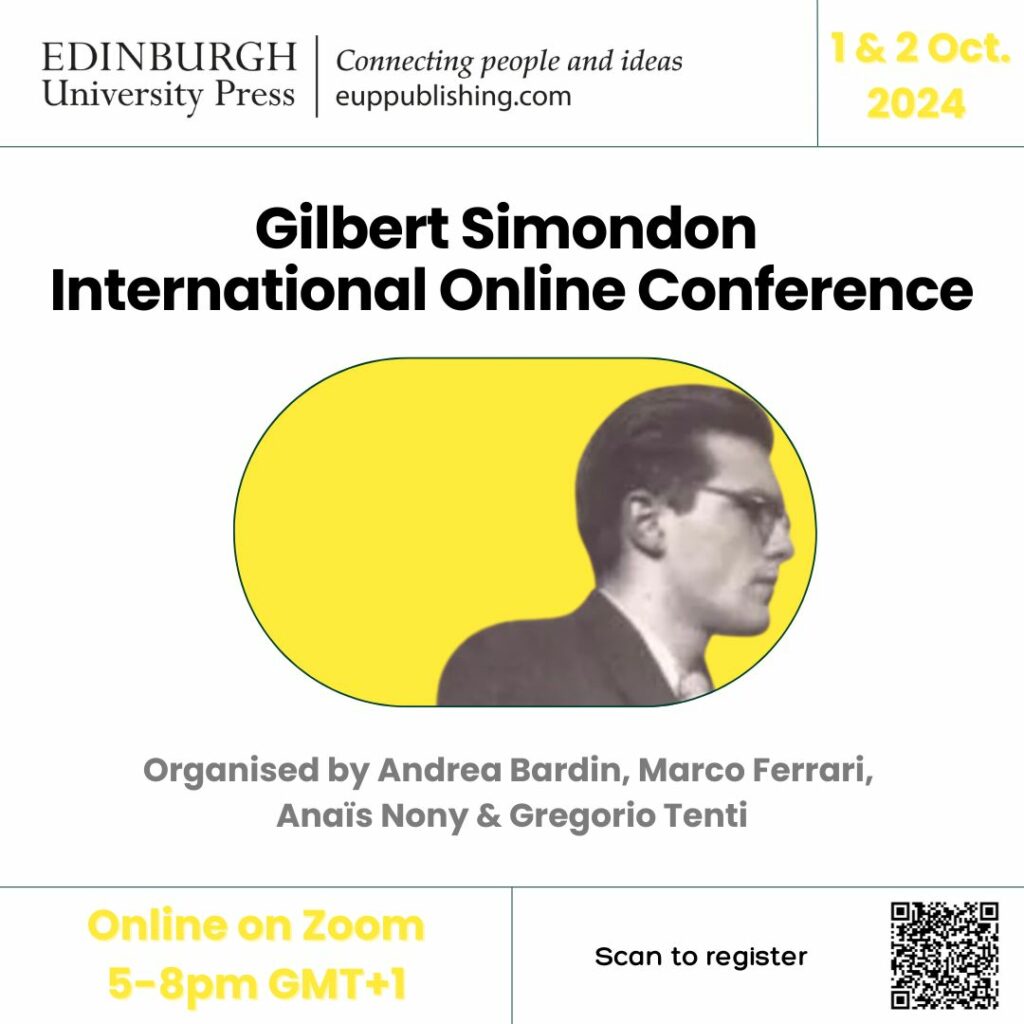
The Edinburgh Companion to Gilbert Simondon is out!
https://edinburghuniversitypress.com/book-the-edinburgh-companion-to-gilbert-simondon.html
Vattimo Seminar – Vattimo Today

https://www.upf.edu/en/web/gianni-vattimo/activities
#C – On theory-to-action research

During this project more than ever before I’ve been led to reflect on the external limits of my own research, which are even narrower when it comes to the great accelerator of academia. But no theoretical gesture in the field of environmental humanities can avoid reflecting on the way it relates (or fails to relate) to its own ‘external’ conditions, that is the socio-economic situation that generated the environmental crisis. One can never be sure that, at the end of the day, their research has done anything more than produce more polluting noise, or in the worst case provide instruments to the great greenwashing operations. It is not certain that including critical elements in the research, or even structuring one’s whole approach in a critical manner, will be enough. Taking direct action, on the other hand, is an incommensurable outcome to any theoretical premise. Those contemporary philosophies that want to found the relation between theory and praxis through theory fall into the most banal of vicious circles. Rather, we must make sure that theory is not created in the vacuum of abstraction, but in real practical interactions with reality: only the thoughts that emerge from praxis can enable certain kinds of praxes rather than others, and are not good for every season, as we say in Italian. Environmental research must not only be critical: it must be biased, or better, non-unbiased. In no way does this come down to stating one’s own political position (solipsism): it rather means informing one’s research perspective as well as one’s academic presence through political situatedness and shared struggles.Biased truths are neither hard and inviolable (objectivism) nor in themselves unusable (relativism): they are ever-changing and useful to life, because they emerge from social interaction and conflict. They are not the incarnation of transcendent ideas or values, but the transcorporeal emanation of actions, contacts, speeches and gestures. Truth production must be political, that is situated and situating. As such, it might be uncomfortable for the single individual, but no single individual is alone in it. Feminisms and Critical Animal Studies among other fields have argued for the impossibility of unbiased research and exposed the problem of academic cooptation. For a philosopher concerned with the political nature of the environmental crisis (regardless of their particular subjectivity), this should be a call for bending the inherited ways of thinking towards non-universality. Thinking non-universally while maintaining a significance for a more or less wide community entails modifying the instruments of thought in the sense of shared concrete realities. Reconstructing the nexus between theory and praxis requires a non-speculative realism that finds its application in a slower, more concrete exercise of thinking.
Save the date – 2nd International Congress of Environmental Humanities
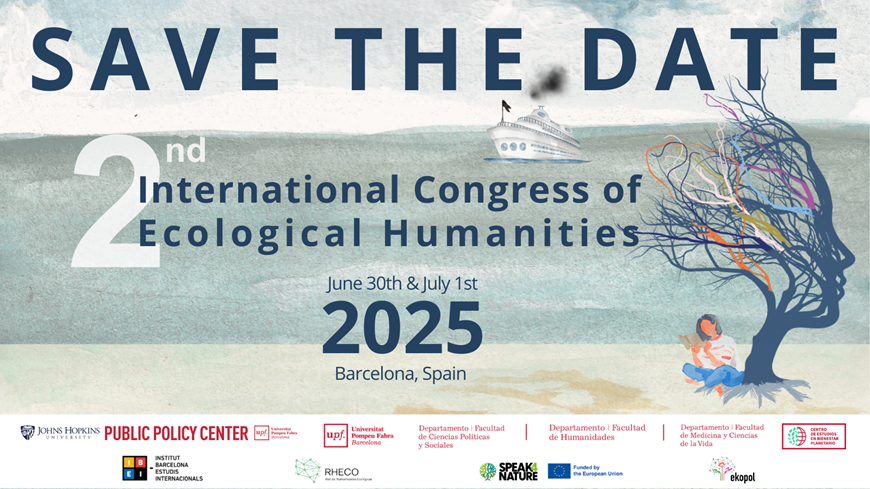
For all information see: https://eventum.upf.edu/124629/detail/ii-congreso-internacional-en-humanidades-ecologicas.html
Save the date – Gilbert Simondon International Online Conference