#C – On theory-to-action research

During this project more than ever before I’ve been led to reflect on the external limits of my own research, which are even narrower when it comes to the great accelerator of academia. But no theoretical gesture in the field of environmental humanities can avoid reflecting on the way it relates (or fails to relate) to its own ‘external’ conditions, that is the socio-economic situation that generated the environmental crisis. One can never be sure that, at the end of the day, their research has done anything more than produce more polluting noise, or in the worst case provide instruments to the great greenwashing operations. It is not certain that including critical elements in the research, or even structuring one’s whole approach in a critical manner, will be enough. Taking direct action, on the other hand, is an incommensurable outcome to any theoretical premise. Those contemporary philosophies that want to found the relation between theory and praxis through theory fall into the most banal of vicious circles. Rather, we must make sure that theory is not created in the vacuum of abstraction, but in real practical interactions with reality: only the thoughts that emerge from praxis can enable certain kinds of praxes rather than others, and are not good for every season, as we say in Italian. Environmental research must not only be critical: it must be biased, or better, non-unbiased. In no way does this come down to stating one’s own political position (solipsism): it rather means informing one’s research perspective as well as one’s academic presence through political situatedness and shared struggles.Biased truths are neither hard and inviolable (objectivism) nor in themselves unusable (relativism): they are ever-changing and useful to life, because they emerge from social interaction and conflict. They are not the incarnation of transcendent ideas or values, but the transcorporeal emanation of actions, contacts, speeches and gestures. Truth production must be political, that is situated and situating. As such, it might be uncomfortable for the single individual, but no single individual is alone in it. Feminisms and Critical Animal Studies among other fields have argued for the impossibility of unbiased research and exposed the problem of academic cooptation. For a philosopher concerned with the political nature of the environmental crisis (regardless of their particular subjectivity), this should be a call for bending the inherited ways of thinking towards non-universality. Thinking non-universally while maintaining a significance for a more or less wide community entails modifying the instruments of thought in the sense of shared concrete realities. Reconstructing the nexus between theory and praxis requires a non-speculative realism that finds its application in a slower, more concrete exercise of thinking.
Save the date – 2nd International Congress of Environmental Humanities
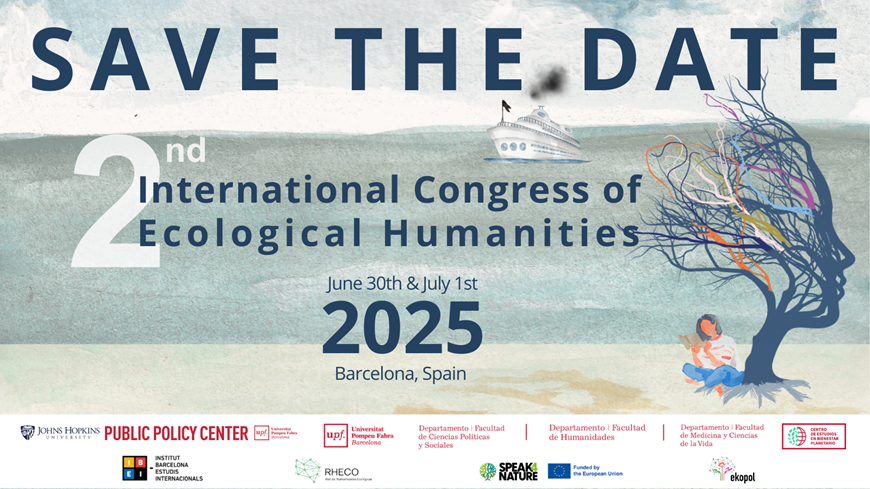
For all information see: https://eventum.upf.edu/124629/detail/ii-congreso-internacional-en-humanidades-ecologicas.html
#a – A critique of this project’s title

Criticizing principles is a philosophical and pragmatic necessity [shaking the foundations to reveal the multiplicity underneath]. This project makes no exception. We shall take its title, “Understanding the Sixth Extinction as a Hermeneutical Challenge”, and proceed in order. UNDERSTANDING is supposed to be the philosopher’s job. But what is understanding? The current state of globalized academic knowledge suffers from an even deeper separation than that between theory and praxis once denounced by Marx (“the philosophers have only interpreted the world…”). It is fractured into a myriad of areas of specialization whose isolation is functional to grant personal authority and enforce the atomization of academic subjectivities, at the same time separating them from the rest of society and from the problems posed by reality. But academic knowledge is also massively overcodified into areas of relevance by means of targeted funding: for example, ethics and logics have become two fundamental vectors of cognitive extraction and real abstraction [i.e., the commodification of knowledge]. These vectors have the effect of mobilizing university as an otherwise immobile system of social exclusion and existential precarity. Understanding depends on transindividual invention and, as such, it is forced to seep in the grid of academic knowledge like an acid. From my own position of privilege, the main instruments that right now I choose to wield with contradiction are solidarity [making alliances to embody differential commonalities and mitigate suffering] and epistemic anarchy/obliquity [becoming elusory in the immanence of thinking]. SIXTH EXTINCTION is the name of the reduction of biodiversity that began with the appearance of humankind and is now dramatically accelerating towards collapse. The association of an ordinal number with something as abstract and radical as the word “extinction” is almost poetic. It emphasizes the fact that there have been other extinctions in the past and there will probably be others in the future, as the Earth is in itself catastrophic; it also suggests that the human presence on Earth has always been extinctive and is now so to an increasing extent. But however good it may sound, the term “sixth extinction” runs the risk of concealing the instable heterogeneity of the present problem. In order to frame the interconnected fabric of stories and struggles flowing collectively into the extinctive drift, we need a materialism of the problem, a way to stay close to it; and if we choose to understand it as a constellation of apocalypses directed towards some kind of “end” [what Guattari called “the conjunction of all possible convulsions”], then we need a materialism of the end. HERMENEUTICS is a respectable philosophical tradition that most people perceive as incapable of providing answers in front of the environmental crisis, essentially due to its logocentrism and ill-concealed spiritualism. For me, hermeneutics is an instrument of concretization. It is useful to claim that reality is not a text, language is not an abstract code and words are actions. Perhaps this materialization of the mediation goes back to Hermes the monistic magician rather than Hermes the Greek god. Finally, the word CHALLENGE seems to echo the neo-liberal habit of encouraging people to make lemonades out of lemons. Extinction is not an opportunity for anyone, or maybe just for the very small group of interstellar owners that would survive in a lifeless future. And it’s not just a matter of adaptation. It is indeed a challenge, however, to what is and has been, in the name of habitable and liberated futures.
#1 – On earthly alliances

We must revise our alliances. Before that, we must revise our myths on “us” – which requires to Dismantle & Diffract the biological and symbolical vectors of identification of our species. We must become beings-towards-alliance. In the future, Chthonian infrastructures will be the primordial forces of the Earth. Each Chthonian will be associated with different earthly agencies. Contrary to certain current beliefs, this will be a time of abundance in which humans will live like gods. Only as a consequence of a long war unleashed by Olympic aliens will humans be forced to form an alliance with one Chthonian, SmEye6.zwu (later known as Prometheus), protector of instrumental intelligence and reflective awareness. Humans will survive, but their political isolation will lead to separation from both Chthonians and aliens. The war will end in the complete anthropomorphization of reality and the symmetrical withdrawal of the aliens above and the Chthonians below. In this story, the human abuse of instrumental reason does not descend from a metaphysical guilt or a transcendental architecture, but from a contingent resolution of complicated events. Intelligence is just one power among many – alongside the wonder of the sea, the fear of hidden marine creatures, strength, dark magic, night divination, knowledge of stars and planets, wisdom, recklessness. Humans must choose their ways of engaging with the Earth in order to keep on being. This is their political ontology. Human alliances must be many and wavering, a continuous exchange that strengthens the very texture of reality without unifying or homogenizing it. An alliance is a contingent and mobile act of ontogenesis within a state of conflict that has to be taken as permanent. To form an alliance with the Earth does not mean to barricade Gaia, but to build platforms that are apt to intercept fluxes from below [telluric f (x)] and from above [cosmic f (x)]. It means leaving behind the aspiration to moralize nature, to live in a discernible and ordered place (a locus mundus), without ignoring the fact that what resists us is not metaphysically separated from us: it is just a heterogeneous mesh of powers that lies beyond our control. Natures communicate and transform in a mutating tangle, and from the tangle come their sovereignty. An Earth is this processual, catastrophic hyper-territory. It has a below and an above. Earthly strata are nested along fault lines of instability; each level emerges due to interior ferment [proliferation] and falls back on the others [decay]. Solar vectors proliferate into cosmic alliances, hylarchic vectors decay into telluric alliances. Making alliance is a matter of projecting new sensory surfaces where to be many and one, in turmoil.
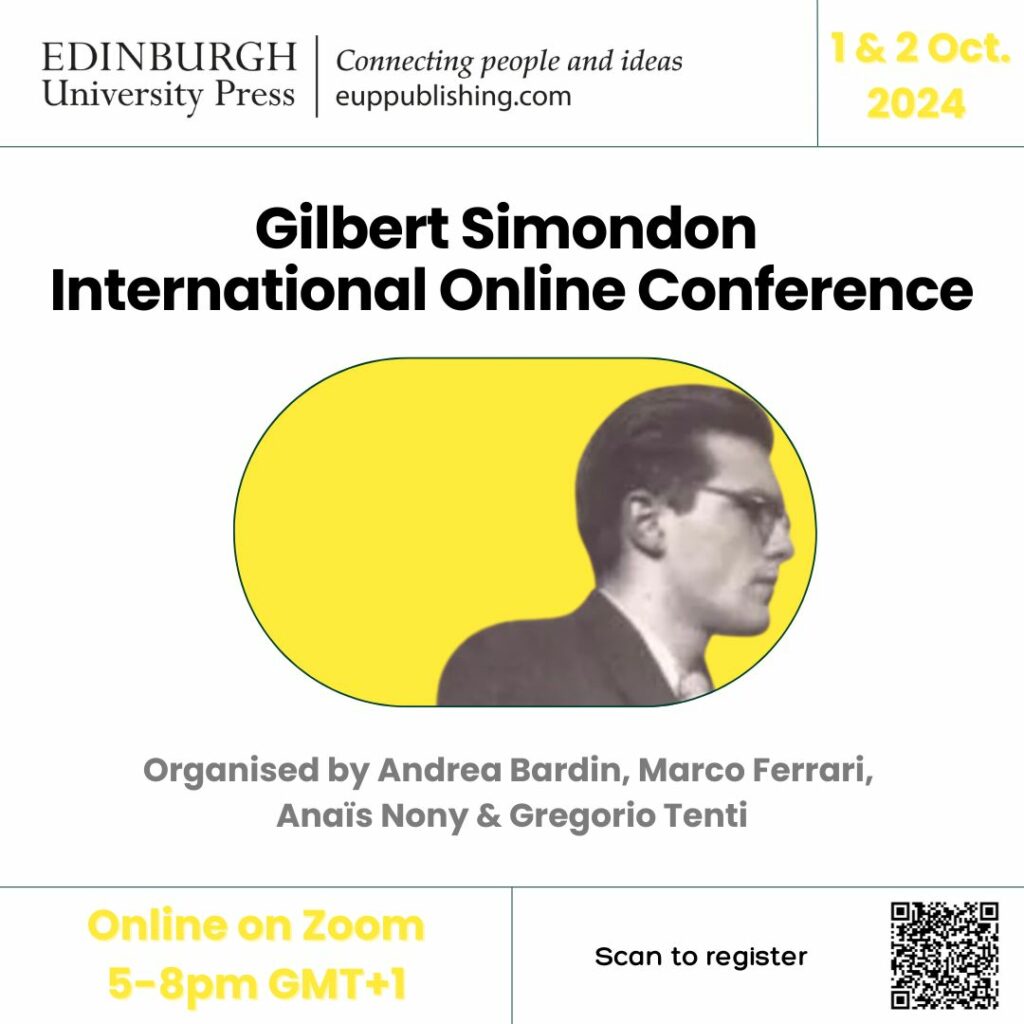
Save the date – Gilbert Simondon International Online Conference